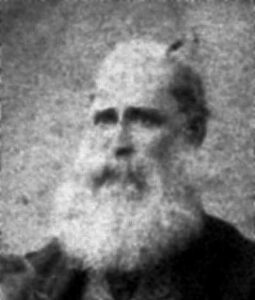
 Maternal twice-great-grandfather, Charles (Carl, Karl) Trompf
Charles Trompf was the paternal grandfather of my maternal grandmother, Nell Massey (nee Trompf). Born in Prussia in 1831, he immigrated to Australia in about 1850.
Within a year he was mining for gold in the Ballarat area of Victoria, a pre-federation state governed by a British colonial administration. Federation would be achieved in 1901.
Trompf would be hailed as an Australian hero for his part in the armed rebellion of 1854 against the colonial Victorian government. The miners viewed the administration as corrupt including (allegedly) murdering people. Their main complaint was the doubling of the price of mining licenses irrespective of whether miners found gold.
This caused severe hardship. Representations were ignored. The miners could either suffer under the cruel yoke of foreign oppression or rebel. With their supporters they erected a stockade of rough-hewn planks, the Eureka Stockade, and hoisted the flag of the Southern Cross, symbolic of Australian sovereignty. The troopers attacked: 22 miners and 7 troopers died.
Some Irish republicans were among the miners but most miners didn't bare a grudge against British colonialism per se except to the extent the British invasion of Australia was to establish penal colonies on the far side of the planet from England, as punishment (we were taught at school) for stealing a loaf of bread because families were staving.
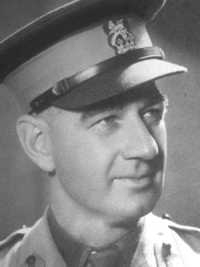 Paternal grandfather, Walter Edmond Smith
Walter Smith, inspired by lancers parading down George Street, Sydney, prior to departure for the Boer War, joined his school's cadet unit in 1905 aged 10.
WWI started 4 August 1914. On the 6th he volunteered, on the 17th he was sailing through Sydney Heads with the AN&MEF (Australian Naval and Military Expeditionary Force) bound for Australia's first military action of WWI.
This was to occupy the German Protectorate of New Guinea administered from Rabaul in the island of New Britain, secure the surrender of the German governor, and garrison the German force there. This meant he missed the intake for Gallipoli, but not for the Western Front.
He survived (just) the 19 July 1916 Battle of Fromelles, Australia's "baptism of fire" on the River Somme, being machine-gunned and shelled (wound by shrapnel).
Britain had assured its devoted colony it would surge up to defend its flanks, but as it turned out had better things to do. Australia broke through the German lines but reinforcements never arrived. There were over 5,000 Australian casualties in 24 Hours.
Walter received the Military Cross twice for gallantry and leadership. He had the honour of conducting Australian Prime Minister, Billy Hughes, and party around the Péronne battle field after the remarkable early-September 1918 Australian victory there (because he had been instrumental in the victory).
Serving on the Western Front for the duration, mid-1916 to late-1918, he was machine-gunned, shelled, gassed and got trench feet, a type of frostbite. For recuperation after hospitalization he was billeted to aristocratic estates in Blighty (Britain). A daughter fell in love, but his heart had been promised to another. He soon married on return to Sydney.
WWII. Now Brigadier MC bar ED, Walter Smith commanded the first force, 5,000 at full strength, deployed to Port Moresby and the Kokoda Track in the 1942 Kokoda Campaign in Papua New Guinea, Australia's most important military campaign. He served for the full duration, May 1942 to February 1943.
However, after war's end his name was deleted from the official military history. In Papua he had struggled against, looting, black markets in Army supplies, and poor intelligence. Finally in December 1942 he threatening to table orders for needless sacrifice "at the bar of the Federal House" unless the murderous sacrifice stopped. These were orders by American Supreme Commander General Douglas MacArthur.
Survivors would later call them:
"orders for "a bloodbath" and "a slaughter of good men."
From the day he stepped ashore in Papua in May 1942 he battled corruption. Papua Administrator General Basil Morris stole his brigade's vehicles then refused to give them back, saying he needed them for administrative purposes.
Smith fought widespread corruption in military supply, and incompetence in military intelligence which was a sort of supply only of information rather than the desperately needed medicines, hospital equipment, tools, and weapons.
"We were using WWI rifles,"
one serviceman complained, and another:
"the bullets weren't made properly and could jam."
Smith was part of the hierarchy but devoted to the welfare of the troops. This, as Commander-in-Chief Field Marshal Sir Thomas Albert Blamey would make clear - was unacceptable. Troops were sorts of ammunition by another name.
After war's end Smith wasn't invited to any end-of-war celebrations or to the new queen's Royal Tour. His name was deleted from the official history and his brigade, the 14th Infantry, unfairly criticized as a way to damn him without mentioning his name.
"I was very bitter and deeply hurt on my return to civilian life at this cowardly and unjust treatment."
During the Kokoda Campaign he had reported to Australia's most corrupt military leader, Field Marshal Sir Thomas Albert Blamey. Blamey was well known even before WWII for his moral failings, and even before being booted as Victorian Commissioner of Police for perjury. He represented such a stark ethical decline from the exemplary WWI command of Sir John Monash.
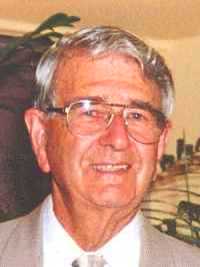 Father, John Louis Bullôt Smith.The Louis Bullôt comes from his mothers side, Huguenots who fled France for England during the Catholic purges of protestants.
My father managed the family firm, W. E. Smith Engineering Pty. Ltd. after his father, Walter Edmond, retired in the early 1960s due to failing eyesight caused by mustard gas, yellow cross gas, on the Western Front in WWI.
In 1917, Walter was blinded for six weeks then recovered well enough at the time. He went on to found the family business in 1922 then built it up to a heavy engineering firm of about 150 staff. But his eyesight got worse with age, and in the early 1960s my father took over.
While in Sydney, John Smith battled Lane Cove Council over planning permission for a new factory. He received a phone call from the Mayor's lawyer. The Mayor was very supportive of local businesses, so much so that he could easily facilitate planning permission. And by the way the mayoralty is an elected office.
A re-election contribution of £3,000 would be ideal. Then permission could easily be granted in three weeks, otherwise it might take two years. The lawyer gave my father the Mayor's bank account number. My father waited two years.
As mayor of Coffs Harbour after the family firm moved there and he retired, he battled corrupt land developers and corrupt companies bidding on infrastructure.
And a corrupt NSW state parliament. Due to pressure from the Greens, it had to pass legislation to prevent the council finishing its sewage treatment upgrade. The trench for the outfall had (in undue haste and largely at night) already been dug. But the Greens were outraged, or at least said they were outraged, at fully-treated sewage being pumped kilometres out to sea. But in reality they were just making political capital out of the concept of poo.
Robert Webster, one on my classmates at Newington, was the state Minister for Planning at the time. At the 1989 Class of '69 twenty-year reunion he bitterly exclaimed:
"Oh my god, you're Coffs Mayor, John Smith's son!"