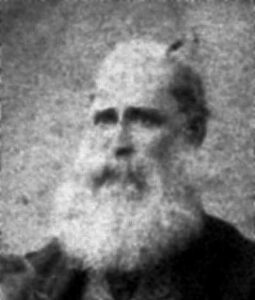
Charles (Carl, Karl) Trompf was the paternal grandfather of my maternal grandmother, Nell Massey, nee Trompf. He was a Prussian immigrant to Australia born in 1831 in Prussia.
In the early 1850s he was mining for gold in the Ballarat area of Victoria, a pre-federation state under British colonial rule.
Trompf would be hailed as an Australian hero for his part in the armed rebellion of December 1854 against the colonial state government, a revolt now celebrated as the harbinger of Australian sovereignty and federation in 1901.
The miners viewed their government as corrupt including (allegedly) murdering people. Their main complaint was the doubling of the price of mining licenses irrespective of whether a miner discovered gold.
This increase caused severe hardship. Representations were ignored. The miners could either suffer under the cruel yoke of foreign oppression or rebel. With local supporters they built a stockade of rough-hewn planks, the Eureka Stockade, and in it hoisted the flag of the Southern Cross, symbolic of Australian nationhood yet to be achieved. The troopers attacked: 22 miners and 7 troopers died.
Some Irish republicans were there but most miners didn't have a grudge against British colonialism except to the extent the British invasion of Australia was to establish penal colonies on the other side of the planet from England, as punishment (we were taught at school) for stealing a loaf of bread because families were starving.
But establishing penal colonies in the most distant British outpost was at least partly due to fear by the ruling elite of a French-style revolution happening in England. Trouble-makers, and hence potential revolutionaries, were shipped as far away as possible.
And the prisoners and their descendants did revolt, they did become revolutionaries. But the revolution against Britain was in Australia and the result was Australian sovereignty and extrication from the cruel oppression of colonial rule.
But the ringleaders of the Eureka revolution were found not guilty by a jury of their peers. The local government was corrupt, but the British legal system wasn't. And that system is the basis of Australian law today.