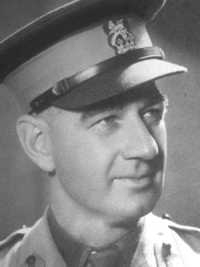
Walter Edmond Smith. Walter Smith, inspired by lancers parading down George Street, Sydney, prior to departure for the Boer War, joined his school's cadet unit in 1905 aged 10.
WWI
WWI started 4 August 1914. On the 6th he volunteered, on the 17th he was sailing through Sydney Heads with the AN&MEF (Australian Naval and Military Expeditionary Force) bound for Australia's first military action of WWI.
This was to occupy the German Protectorate of New Guinea administered from Rabaul in the island of New Britain, secure the surrender of the German governor, and garrison the German force there. This meant he missed the intake for Gallipoli, but not for the Western Front.
He survived the 19 July 1916 Battle of Fromelles, Australia's "baptism of fire" on the River Somme, being machine-gunned and wounded in the head by shrapnel.
Britain had assured its devoted colony it would surge up to defend Australia's flanks. Australia broke through the heavily-defended German lines, but Britain didn't bother to arrive. Over 5,000 Australians were casualties in 24 Hours.
Walter received the Military Cross twice for gallantry and leadership, personally received his medals from King in Buckingham Palace and met a "very plain looking" princess. On 14 September he conducted Australian Prime Minister, Billy Hughes and party, around the Péronne battle field after the remarkable early-September 1918 Australian victory there. He was given the honour because of his part in the victory in the last major battle of WWI, the battle that it's thought convinced Germany all was lost.
5 September 1918
Field [Péronne]
My darling girl,If ever a man was thankful for being alive today that man is me. I've just come out of the heaviest engagement I've ever been in and I am just about worn out.
The GOC [Monash] said yesterday that he was amazed to think we went where we did. According to all rules of warfare it was impossible for us to get where we did. The cruel fighting, he said, had never been surpassed on the Western front. Not even the landing in which he took part was a patch on what we went through...
[I started out commanding B Company.] Before we had gone two hundred yards I was commanding the regiments of A and B Companies. We were held up by heavy belts of barbed wire and mown down by murderous machine-gun and shell fire. How we got through God only knows.
We drove the Bosch out of a wood and he got in behind us. We dug in, and a huge mine blew up about a hundred yards in front. The shelling was awful. For 36 hours we were subjected to intense shell and machine-gun fire from the front, flanks and rear.
Once we tried to advance again and were severely punished and were forced to withdraw.
The Bosch held all the high ground and fired at us over open sights. B Company that I started off with came out with only 8 men [out of about 160]. My God...
...Stan Evers is badly wounded and so also is poor old Tof. We buried poor old Lamerton yesterday afternoon. It fairly broke me up. My batman Cullen was also killed. His people live in Leichhardt. You might go and see them. I’ll send you their address.
To mother:
6 September 1918
Field [Peronne]
My darling mother,...I am OK, thank God...Poor old Lammie was killed during the attack on Peronne early on the morning of the 1st September. He was gallantly leading his platoon forward through what is now recognised to have been the most intense and murderous machine-gun fire and artillery barrage ever yet witnessed on the Western Front.
Only eight men came back out of my Company, and how they ever got through I'll never know. Tof was wounded badly in the right shoulder. He did wonderful work and deserves a VC.
Shortly after jumping off, his platoon was held up in front of a machine-gun nest by a cruel belt of barb wire. The machine-gun fire was terrific, but Tof crawled forward with two men to cut the wire. He was wounded badly, and although bleeding freely, encouraged the lads to carry on with the task.
When the gap was cut, he insisted on being lifted up utterly regardless of his own personal safety and led the rush through the wire, killing the crew of a machine-gun by firing his revolver left handed.
Although unable to go further forward himself, he re-organised his platoon and encouraged them to push on. The SBs [stretcher bearers] wanted to carry him out but he refused to allow anyone to touch him until all his men were cleared off the field.
That's the spirit that is winning this war, and what is gaining for the Australian forces worldwide fame.
But Tof was only one of many, [and] all were brave. Lieutenant Smith, whose photo I've sent you, approached a Bosch strong post, and with only three other men rushed it. Thirty Fritz surrendered. But while he was getting them out of the post, one of the Jerries shot him in the back. He went absolutely raving mad for a moment and emptied his revolver into them before he dropped. He's very badly wounded.
Stan Evers has a nasty wound in the thigh. When he fell, the Company SBs rushed to him but he bade them leave him alone and pressed on to the attack.
Another one of my officers, Bevan, during the 2nd attack the same afternoon, went through a hail of lead, and reached his objective with only six men, and found that both his flanks were in the air, and the Bosch were in behind him.
Nothing daunted, he hacked his way back, returning through Peronne and rejoining me. And so on, could go on telling you tales for hours.
But enough. ...We sat for 36 hours after the positions were taken practically in a slaughter yard being fired on from front, flanks, and rear...
Fritz had picked guards who had volunteered to stop the Australians (and they did try) but they are at this moment in full retreat and the whole sky is ablaze with the burning villages and dumps.
Serving on the Western Front for the duration, mid-1916 to late-1918, Captain Smith was machine-gunned, shelled, gassed and got trench feet, a type of frostbite. For recuperation after hospitalization he was billeted to aristocratic estates in Blighty (Britain). A daughter fell in love but his heart had been promised to another. He soon married on return to Sydney.
WWII
In WWII, now Brigadier MC bar ED, Walter Smith commanded the first force, 5,000 at full strength, deployed to Port Moresby and the Kokoda Track in the 1942 Kokoda Campaign in Papua New Guinea, Australia's most important military campaign. He served for the full duration, May 1942 to February 1943.
After war's end, his name was deleted from the official military history. He had struggled against, looting, black markets in Army supplies, and unreliable or absent military intelligence, finally threatening to table orders for needless sacrifice "at the bar of the Federal House" unless the needless sacrifice stopped. These were orders issued by American Supreme Commander General Douglas MacArthur.
Survivors would later call them:
orders for "a bloodbath" and "a slaughter of good men."
From the day he stepped ashore at Port Moresby Brigadier Smith battled corruption. Administrator Major General Basil Morris stole his brigade's vehicles then refused to give them back, explaining he needed them for administrative purposes.
"Next morning I was astonished to learn that the New Guinea Administrative Authority had taken possession of a large number of the Brigade’s transport vehicles. It was only after the strongest protests that I got the bulk of them returned."
The judgement of Administrator Morris was almost criminal. Soon after arrival, Walter prepared an "appreciation" of the forces needed to defend the Port Moresby area:
"It was my considered opinion that the minimum number of troops required to hold Port Moresby and surrounding areas would be three Divisions."
And:
"Three days later a conference was called in Port Moresby of all senior officers of Navy, Army and Air Force. The outcome was that the Administrator [Morris] stated quite bluntly that we were making a mountain out of a mole hill. He was quite sure that the Japanese would be held at a place called "The Gap" in the hills, by a machine gun defence system. He would not ask Army Headquarters for additional troops. There the position rested."
Smith fought widespread shortages in military supply not only of reliable intelligence but the desperately needed medicines, hospital equipment, tools, and weapons.
"We were using WWI rifles,"
one servicemen complained, and another:
"the bullets weren't made properly and could jam."
Smith was part of the hierarchy but tried to avoid needless suffering and death. This, as Commander-in-Chief Field Marshal Sir Thomas Albert Blamey would make clear, was a serious error. Troops were sorts of ammunition by another name.
After war's end Smith wasn't invited to end-of-war celebrations or to the new queen's Royal Tour. His name was deleted from the official history and his brigade, the 14th Infantry, unfairly criticized as a way to damn him without mentioning his name. Shortly after war's end he wrote:
"I was very bitter and deeply hurt on my return to civilian life at this cowardly and unjust treatment."
During the Kokoda Campaign he had ultimately reported to Australia's top soldier, Field Marshal Sir Thomas Albert Blamey, who represented a stark moral decline from the exceptional command of WWI's Sir John Monash.
Monash had been among the prime ministerial party Smith conducted around the Péronne battlefield on 14 September 1918, the last major battle of WWI on 1 to 3 September:
14 September 1918
Conducted the Prime Minister Billy Hughes, General Monash (Corp Com), General Rawlinson (Army Com), Mr Marlow (Daily Mail), Robert Blanchford [Blatchford?] (writer), and Lord Burnham over the Peronne battle field.
And less than two months latter:
Monday 11 November 1918
Peace! Armistice signed at 6 am, placarded at 11 am. Wonderful scenes in the boulevards. Girls fell on your neck and kissed you. French officers shook hands. Everybody commenced to shout, sing and dance. Flags everywhere. Use to have to look at my arm now and again to see what sort of girl was on it.Tuesday 12 November 1918
Public holiday. People, mostly American soldiers, parade the streets. Everybody seems mad. ... Great fun in the crowd. Had a splendid dinner at P [and] fun at the Folies Bergère... The fountains in the squares are working again. Streets ablaze with light.